Few weeks ago, I went to Acharya Institute of Technology on Hesaraghatta Road, Bengaluru. I had not been there in decades. A quarter century ago that building stood almost alone, up on a small hillock, fields and green stretching out around it. One of its kind. I remembered it that way.
That is not what I found. Dust, Dirt, Garbage piled at the edges of roads that did not used to exist. I stood there looking at it and the only thing I could think was, is this really progress? Because it did not feel like it. It felt like something had been taken and nobody had bothered to notice.
Every day we look at the rising glass buildings and the fresh, white-topped roads and the new flyovers and we tell ourselves Bengaluru is growing. But underneath that, quietly, we are burying the soul of the city under wet cement.
There is a Sanskrit line I keep returning to – माता भूमिः पुत्रोऽहं पृथिव्याः (The earth is my mother, and I am her child). If that is true, and I believe it is, then when did we decide that choking her in asphalt counts as growing up?
I have watched this happen in slow motion across the city I know. The old lake bed near the Outer Ring Road. The huge rain trees near Jayanagar and Indiranagar, that canopy that used to close over the road like a roof. The 100ft road in Indiranagar, which I have watched come apart over the last decade. There is a Kannada saying, ಹೊಸ ನೀರು ಬಂದಾಗ ಹಳೆ ನೀರು ಕೊಚ್ಚಿ ಹೋಗುವುದು. When new water comes, the old water is washed away. That is what happened to those streets. The old bungalows sold one by one, the ones with a garden in front and a garden behind, and in their place went up glass buildings with no parking, and the cars spilled out and choked the roads that the trees used to shade.
Out near BIAL it is the same story. There used to be a ಕಟ್ಟೆ under an enormous banyan, a place where people sat. Birds in the quiet of the morning. Now there are roads and tech parks.
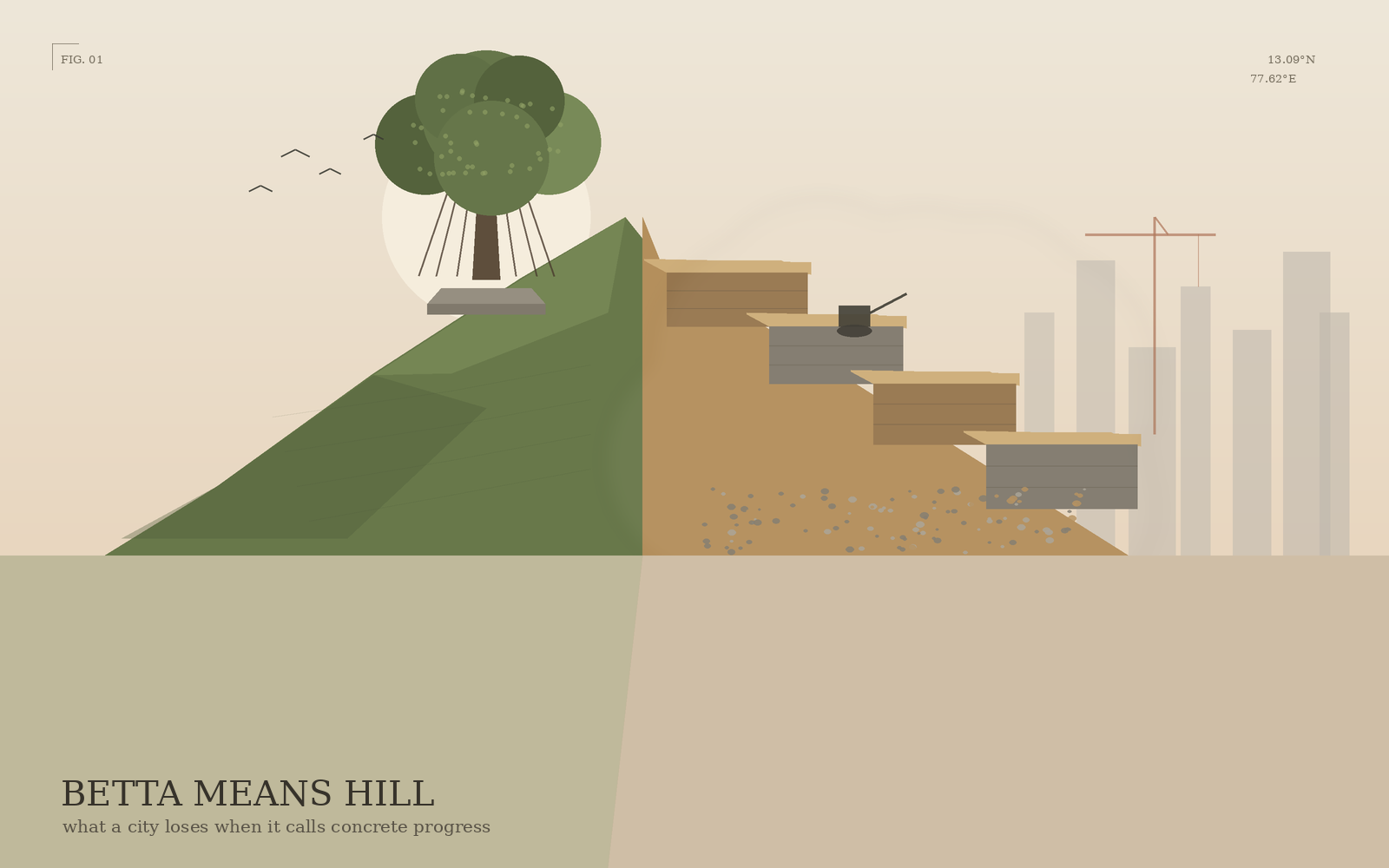
And then there is Bettahalasur a.k.a Bettadahalasuru. The name means hill. That is the joke of it now, because the hill is going. It has been eaten into for stone for years, one blast at a time, and every time I pass that way there is a little less of it than before. A hill does not grow back. It took the earth however many thousand years to push that rock up, and we are taking it down in a single generation to make gravel and floor tiles. And when the last of it is finally carted off, watch what happens. Some builder will put up a gated layout on the flat ground where the hill used to stand and name it after himself. Betta will quietly drop off the sign. It will become So-and-So Enclave, or Somebody Nagar, and in twenty years a child there will have no idea a hill ever gave the place its name. We will have blasted away the hill and kept the real estate.
And across Bengaluru, from what I have seen, a lot of that construction sits on land that used to be lake, on the low ground where water naturally collected before someone decided it should collect somewhere else. I cannot prove every case. But you do not build that much, that fast, on that kind of ground by accident.
The thing nobody wants to say plainly is that the people who plan this do not seem to ask the people who actually understand it. IISc is right here. Their researchers have advised cities well beyond ours. My impression, watching how this city gets built, is that the bodies making the decisions would rather pay crores to a contractor who copies a plan drawn up for some other place than sit down with someone who has studied this exact soil, this exact water. Maybe I am wrong about the details. It does not look like I am wrong about the result.
ನಾವು ಕಳೆದುಕೊಂಡಿದ್ದು ತುಂಬಾ ದೊಡ್ಡದು. What we have lost is huge. We lost the city’s breathing room. And no spreadsheet can hold that loss, because there is no cell for a cool afternoon in a city that was once famous for exactly that, no line item for a lake that used to swallow the monsoon without anyone thinking about it.
The change in how you see it comes slowly and then all at once. It arrives the day the lake pushes into your living room because the drains it used to run through are buildings now. It arrives when you cannot walk outside without a mask. It arrives when the temperature sets a record in a place that never needed air conditioning.
I am not saying stop. I am not against progress. I am against the idea that progress requires us to destroy the thing that keeps us alive. Real progress protects life. It does not pave over it.
So here is what I actually find myself wishing. ಹೊಸ ನೀರು ಬಂದು ಹಳೆ ನೀರು ಕೊಚ್ಚಿ ಹೋಗಲಿ. Let the new water come and wash the old away. Only this time let the concrete and glass be the old water. Let these properties pass to new hands who tear out the tile and put the trees back, who choose to live surrounded by green again.
Disclaimer: The thoughts and views in this piece are entirely my own. AI was used only to help with grammar and proofreading.